
As graduation from college at the UW approached in the fall of 1976, most of my friends had either started working at their first job or were continuing their post-graduate studies. I had applied to medical schools but had not heard back yet whether I would be accepted.
So rather than wait impatiently to hear, I decided that it was time again to be a ski bum at one of the best ski areas in the world – Jackson Hole, Wyoming. What I did not see coming, was that winter would be a bust in Jackson.
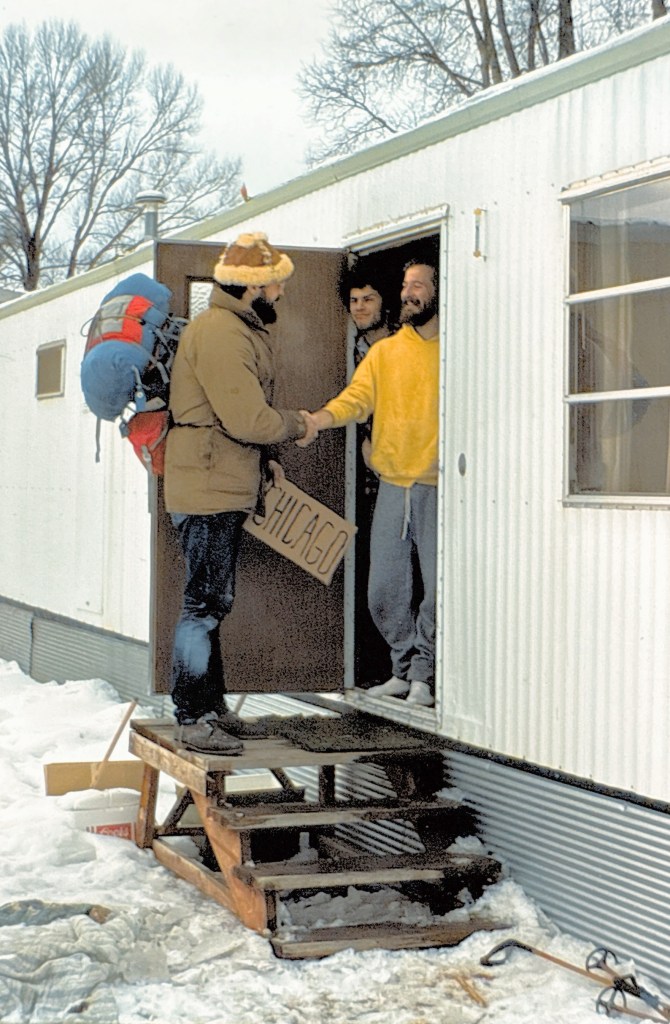
Together with my friends Bob and Joe, we left Madison in early January, driving Bob’s parents’ yellow Audi sedan. Our friend Hugh had moved to Jackson earlier in the season and had room for us to crash in a mobile home that he was sharing with a local. What could be better?
But when we arrived, we were surprised to learn that the ski area had not even opened yet! On January 12, a columnist for the local paper wrote “The Jackson Hole area is currently experiencing one of the strangest winters that can be remembered by damn near anyone” https://jacksonholemagazine.com/winters-of-wonder/.
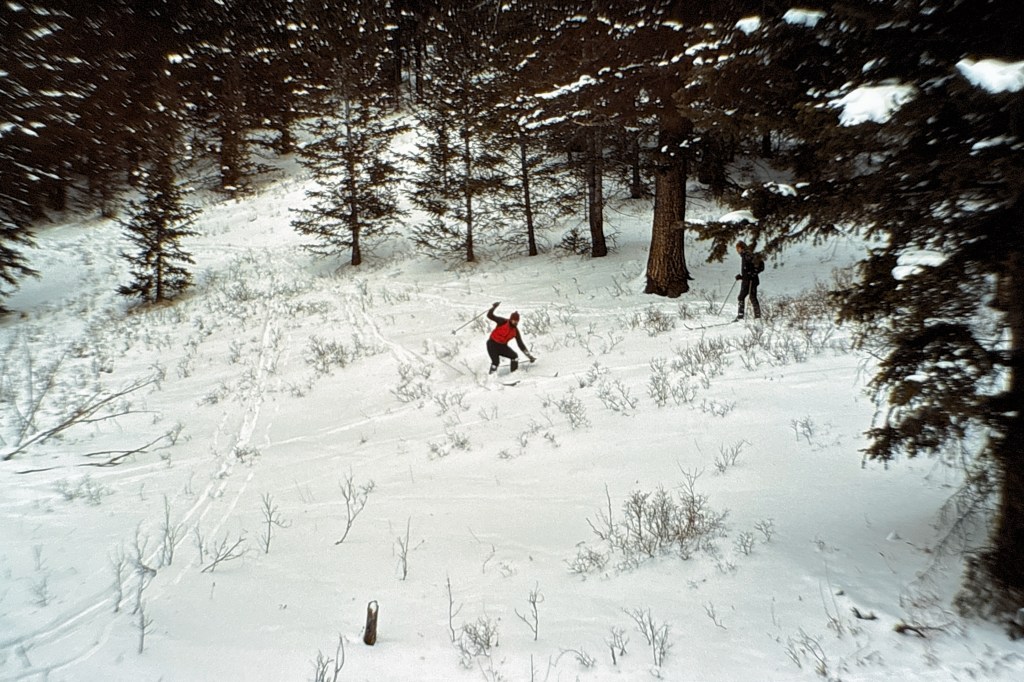
Fortunately, we had brought along our cross-country skis so the next day we headed out north of Jackson to find what little snow had fallen. Although the scenery was spectacular, the lack of snow made skiing really challenging. The downhills were especially treacherous with trees and brush poking through the snow to catch your ski and send you tumbling.
Sensing a need for more adventure, we decided to go winter camping for the first time ever. We packed our backpacks with sleeping bags and a tent and skied into the Lewis River Canyon at the southern entrance of Yellowstone. After a vigorous ski in, we found a spot near a hot spring to camp. As darkness came upon us we set up our tents, ate quickly and crawled into our sleeping bags.
We did not think at the time that going to bed at 5 o’clock in the afternoon would be a problem. But it was. For the next 15 hours straight we did not sleep and instead tossed and turned waiting for the sun to rise. As soon as it did, we packed up and headed straight back to the car.
After our misadventure winter camping, Jackson Hole finally opened, but there was so little snow and all of the more challenging runs were closed. Joe decided to call it quits and hitchhike back to Madison.
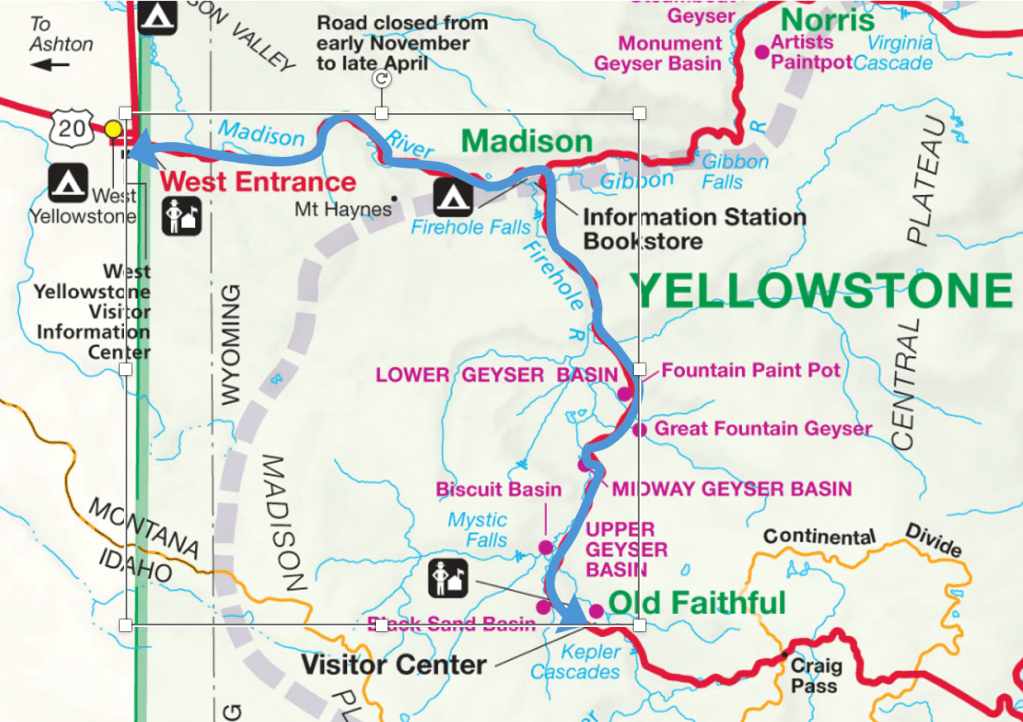
But Bob and I decided to take advantage of the lack of snow and warm sunny weather and drive north to West Yellowstone to see if we could go into the park. When we arrived, we found a snowcat that would give us a ride the 30 miles up to the Lodge at Old Faithful.
We arrived at the Old Faithful Lodge and were in awe with what we saw. Just as we arrived Old Faithful erupted and shot hot water and steam into the frigid air.
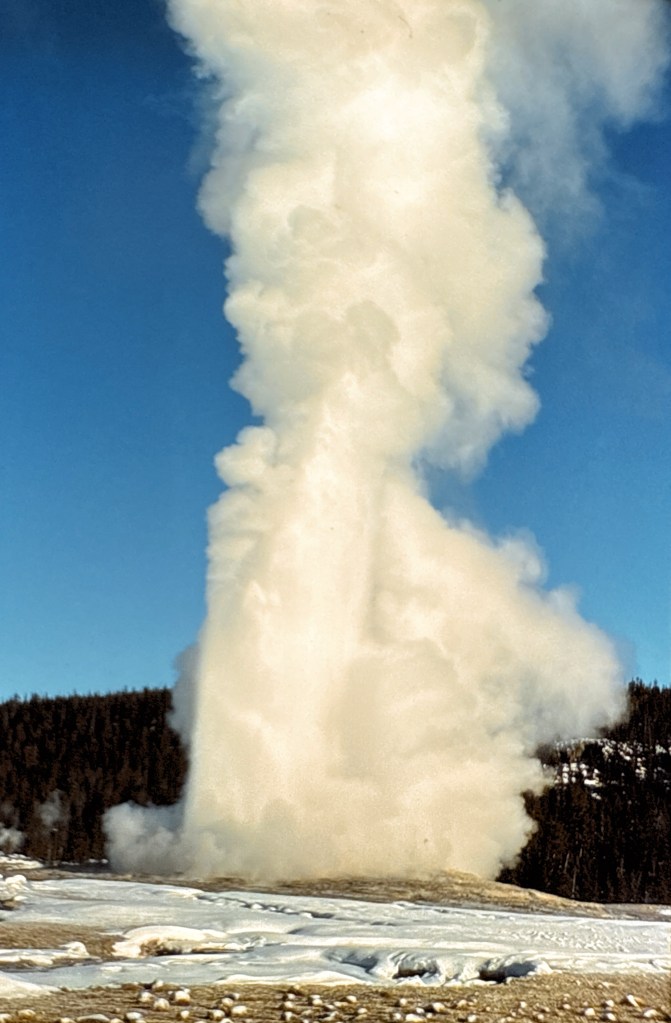
We went inside the lodge and sat in the large chairs surrounding a massive fireplace. We wondered if someday we’d have enough money to stay inside rather than heading outside to pitch our tent.
As the sun set, we decided to pitch our tent close by and picked a spot that was overlooking the Lodge with a full view of Old Faithful.
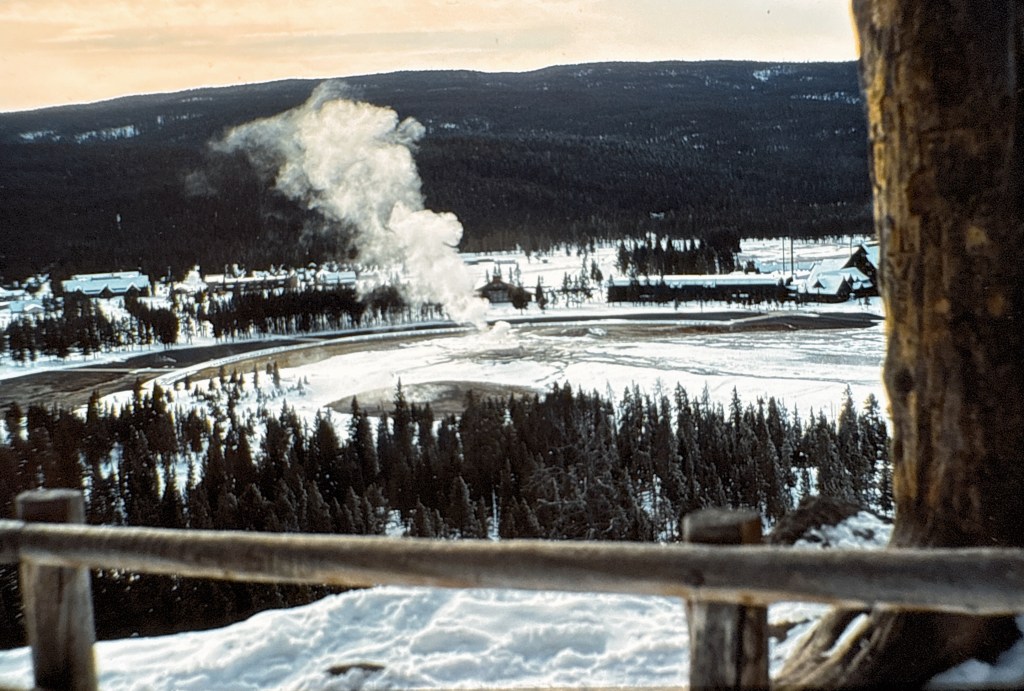
We had no plans and no place to go, so we decided to take each day at a time. And the silver lining to the lack of snow was constant sunny and warm days. It was so incredible that we stayed there for nine days!
We’d start each day in the Lodge, warming up and eating our breakfast. Then we’d head out to explore various parts of Yellowstone Park, including Fairy Falls, Mystic Falls, the Shoshone Geyser Basin, and Mallard Lake.

It was an incredible feeling of freedom to be there without any schedule. Each day brought new discoveries and new challenges. Looking back we took risks that we probably should not have, like crossing streams or getting too close to the bison.

The nights were a completely different story. The first few nights, the temperatures dropped to nearly zero degrees. It was cold but tolerable. But as the days went by, the nighttime lows dropped. On the 7th night the temperatures dropped to minus 20 degrees.
It was then that I discovered a fatal flaw in my sleeping bag. My mom had found the bag on sale and it was made of about 1 inch of open-cell foam. The problem was that the moisture from my body went through the foam and froze solid. After only a few hours, my bag was a 1-inch-thick piece of solid foam. Worse yet, every time I moved even a little bit the bag acted as a baffle causing a complete air exchange inside my bag.
My only option was to remain fully clothed and lie motionless all night long. I suspect that I dozed off on occasion, but I mostly laid there awake wondering what it would feel like to freeze to death—and wishing my mom had bought me a sleeping bag like Bob’s mom bought him.
The next morning, we decided that it was time to go home. We loaded our packs and for some reason decided to ski out the 30 miles on the snow-covered road. With the colder temps, the snow was slow and we only made it about half-way before darkness came.
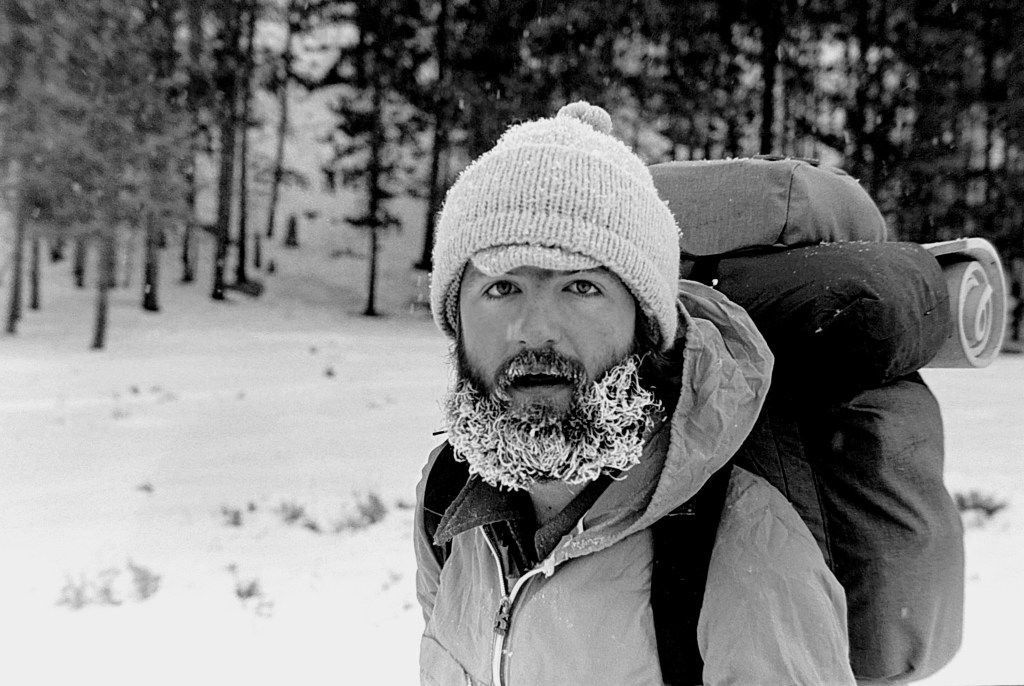
Cold, tired, and hungry, we decided that our best option was to sleep on the floor of the bathroom at the wayside at Madison Junction, hoping that no snowmobilers would drop in to use it. It was another long night.

We made it out the next morning and slowly warmed up in the car. We then headed east on I-90, planning to drive straight through the night back to Madison. We lamented that the last chance in our lives to be ski bums was a bust.
But as the sun set and moon rose, we noticed that we could barely see the road in front of us. Our headlights were not working. So, we pulled into a small town at midnight and three kids opened the hood and then tightened the fan belt that charged the battery. They predicted it wouldn’t last. It didn’t.
After driving through the night and with the sun rising in the east, the engine suddenly quit. We rolled to a stop on the shoulder of the interstate. We opened the hood of the car and saw that the belt that ran the alternator and charged the battery, had busted. Without that belt, we could not move. And with the windchill well below zero, we were afraid to walk or hitchhike to the next town.
But just then an 18-wheeler slowed and pulled up and stopped in front of our car. The trucker got out and came over to look at our engine with us. Seeing the missing belt, he pointed to my boots and told me to take out my lace and use it as a belt. I was suspicious but did as he said and was shocked to see it work and the headlights slowly come back to life.
We thanked him and he was on his way. We had to drive to several towns along the interstate before we found one that had a gas station with a belt. When we did, I took the boot lace and put it back on my boot. And every time I laced up that boot afterward, I thought about how we made the best of a winter that wasn’t.
According to the Jackson paper “The U.S. Bureau of Reclamation said the winter was the driest on record…That was the year it didn’t snow—or rain—or hail—or sleet…If we live long enough, the winter of ’77 will certainly be one we’ll be telling our grandchildren about.”
But rather than telling our grandchildren about how that winter was a bust, we’ll tell them about what it’s like to winter camp in Yellowstone and how a boot lace can save the day.
For more photos, see: https://photos.app.goo.gl/YBQsWeE8mKX6CjjW9
POST-SCRIPT: While in Jackson, I heard that I’d been accepted to the UW medical school. Having applications still pending at other medical schools, I wrote to them on Jackson Hole postcards, “I have decided to withdraw my application. Sincerely, Patrick John Remington.”



 don't follow pat
Leave a reply to Jeff Brown Cancel reply