Easter Sunday in late March 1986 was one of those unforgettable warm and sunny spring days, when you can’t wait for summer to start at the end of a long cold winter. But we’ll never forget how that day might have ended for us, when we went canoeing on the Apple River.
My wife Katie and I, and our two kids (ages 1 and 2) had a wonderful Easter breakfast at the home of my brother Jim and Judy Remington, in New Richmond, Wisconsin. As the temperatures rose into the 70s, we decided to get outside to enjoy the weather. And what better way to do that than in a canoe? My brother Jim and sister Ann were excited about joining us on the river. (Someone must have agreed to watch our kids, but I don’t recall this detail).
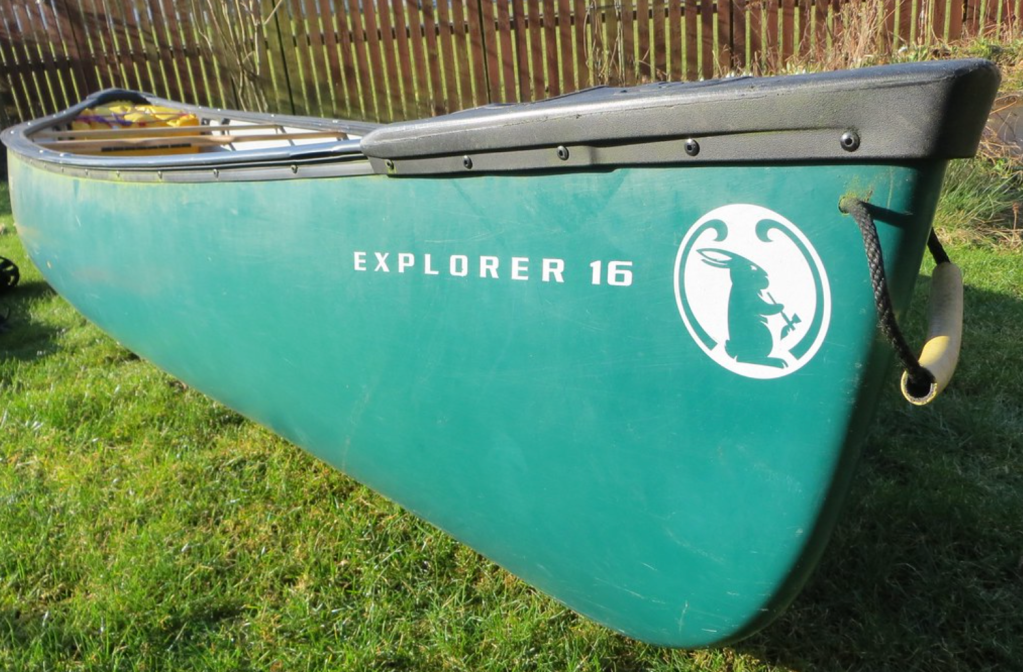
Katie and I were thoroughly prepared for paddling that day. We had brought along our life jackets and a safety rope. And our Mad River Explorer canoe was fully decked out for whitewater with knee straps and bow and stern ropes.
But we should have checked with Jim and Ann, to make sure that they were similarly well prepared.
As we drove to the Apple River in our red VW Bus, we crossed a few bridges and noticed high spring water levels on the creeks and streams. The snow had only recently begun to melt and the riverbanks had ice frozen on the water’s edge. In fact, with the rising water levels large sections of ice had broken off and were floating in the river.
Just then, we began to descend the steep and winding road which entered the river valley. After several minutes we came to a restaurant on the banks of a rushing stream. We hopped out of the van, and Jim said that this was where we would end our paddle. So, we left his car there and we all got in our van to head upstream to the put‑in.

I remember being warm and dry and listening to Bruce Springsteen on the cassette tape player. However, that feeling of warmth and comfort would be short-lived. Jim insisted that we turn off and drive down a narrow twisting road to get a sight of the most challenging rapids on that stretch of the river.
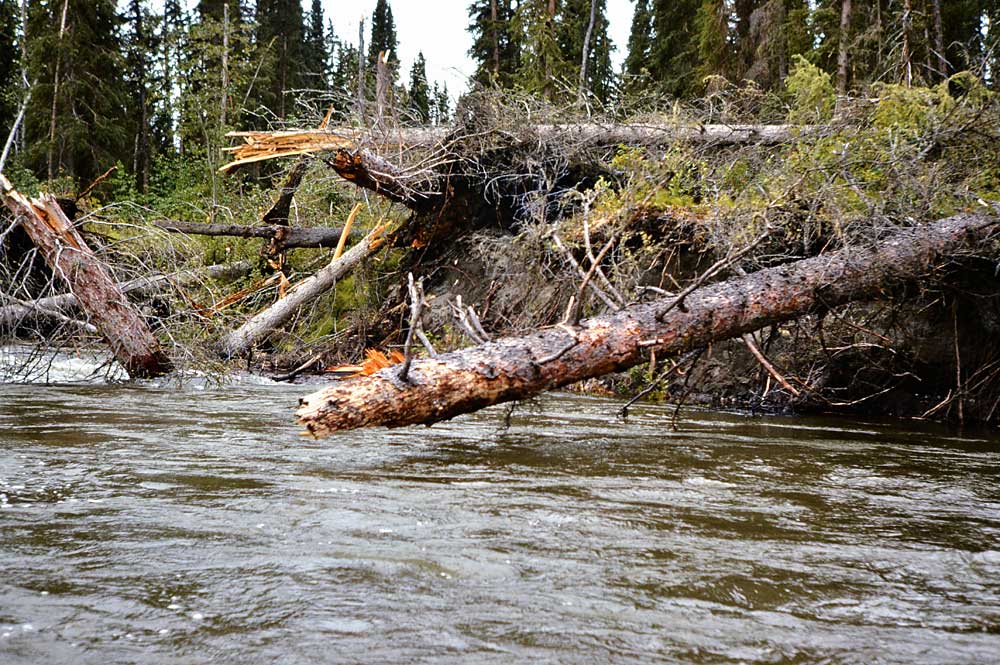
We parked next to the bridge and walked out to look at the rapids. Jim pointed them out far upstream, barely in sight. My first thought about the preferable route was to stay far river right and sneak by a large tree that had extended from the bank, into the river. These are called “sweepers,” as an untrained canoeist can be swept into the river after striking the tree.
We hurried back to the car and finished the drive to the put-in. I put my small Olympus camera in my shirt pocket and Jim carefully put his gold watch (purchased while on active duty in Southeast Asia) into a dry‑bag.
It was only then that I noticed that Jim had only brought along seat cushions for his Grumman canoe.
In an act of chivalry, I offered my life jacket to Ann. She and Katie Ann put them on, and Jim and I placed the seat cushions securely beneath the seats of our respective canoes.
We pushed off and began to soak up sun in the 70-degree weather and practice some of our rusty maneuvers from the fall before. The current was very fast, and soon we glided by a beautiful home on the edge of the river.
It was then when we noticed that the normally quiet rifles along this stretch had been transformed into 3-foot standing waves. Katie and I dropped to our knees and took only a little bit of water‑‑but it was exciting. While still reveling in the warm weather and the thrill of canoeing in the fast‑moving icy stream, we came upon a sharp bend in the river.
Katie and I charged ahead and prepared for some tricky turns in the fast-approaching rapids. There it was: the dangerous log that we had seen, protruding into the river from the left bank of the river. But here’s the point of the story where there are two versions of what happened next.
As I recall, just as Katie and I made it by the sweeper, we heard a thud from behind us and looked back to see Jim and Ann’s canoe hit the sweeper broadside. They had tipped upstream and were both dumped into the icy waters of the river. For the few seconds that we diverted our attention to them, our canoe was suddenly heading toward another sweeper just downstream on the right side of the river. Katie put her paddle into the river and drew the front of the canoe past the sweeper, but there was no way for me to avoid it. The tree hit me in the stomach, and I held onto it, stopping our canoe dead in the water. Water rushed into our canoe, and we submerged into the icy water.
But according to Jim: “When Ann and I came around the corner, we saw you and Katie broadside in the river, pinned by the tree and taking on water over your upstream gunnel. At that point, we had two options: either hit your canoe broadside with the bow of our canoe or do an emergency maneuver by dumping the canoe and ejecting ourselves from the canoe. We opted for the latter option.”
And Ann concurs with Jim: “As we came to the rapids, Pat said that he and Kate should go first to scout out the best route down the river. Jim and I readily agreed as we thought at the time that Pat was the better canoeist. So, we patiently waited as Pat and Kate disappeared from view around the bend in the river. After waiting a sufficient period of time for them to clear the rapids, Jim and I paddled around the bend where we shockingly saw Pat and Kate blocking our route, both overboard hanging on to their canoe. We had a choice to either hit their canoe broadside or quickly pivot our canoe to a less favorable route. We chose the latter only to capsize ourselves as we tried to paddle sideways to the current.”
So what really happened? It is well known that “trauma memories – like all memories – are malleable and prone to distortion” (see: Effect of Trauma on Memories).
Regardless of what the precise sequence of events was, at that point all four of us—in the company of chunks of ice and two swamped canoes—were floating downstream at the mercy of the Apple River.
Luckily, Ann and I floated into a large eddy downstream from the sweeper on the right side of the river along with our water-filled canoes. Katie, floating in her life jacket, managed to cling to the far-left rocky shore.
But Jim was not so lucky. As we made our way to the riverbank with the canoes, we noticed Jim holding on to a sweeper with his legs flapping in the current. Ann and I yelled at him to let go, but the icy waters had slowed his reflexes. He eventually let go, and floated by us, eyes wide open as his head bobbed above and below the water level. As he came to a shallow section of the river, he tried to stand up, but stumbled as the icy waters knocked him down. After what seemed an eternity, he was able to make it to the edge of the river.
We re-grouped and Katie went after the paddles that had floated downstream and Ann and I emptied the canoes of water. My camera and Jim’s dry-bag had disappeared.
We all got back in the canoes and resumed our paddle downstream. The sun disappeared behind the clouds and the temperature began to drop. Shivering from the cold, we soon made it to the car at the take-out and turned on the heat to warm us.
We agreed that we were lucky to have only lost a dry-bag and a camera that day (and thus no photos to illustrate this story). We were fooled by unseasonably warm weather and it was a mistake to go without a life jacket.
After an experience like this, some might say, “I’ll never do that again.” But taking risks often involves making mistakes. Our baptism in the icy waters of the Apple River taught us valuable lessons, and we’ll be more prepared the next time summer arrives early in the spring.
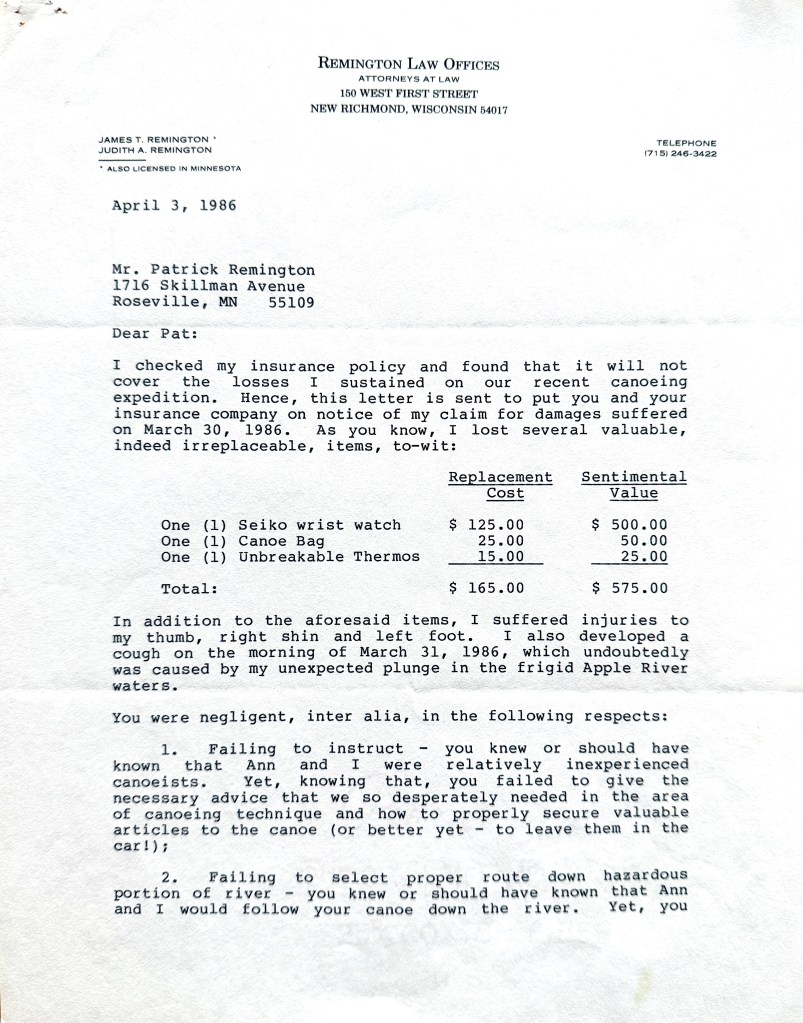
ADDENDUM: A year after I wrote this story, I came across a letter that I had received following this misadventure. So in the spirit of full transparency, here’s the letter in its entirety:

More information the Apple River

 don't follow pat
Leave a comment